If you run advertising on your sites, your consent management platform is not a compliance checkbox. It is the gate in front of your revenue. Every visitor who leaves without a choice recorded is a visitor your ad stack cannot monetize and your analytics cannot see.
Plenty of publishers run Usercentrics. The reasons they start comparing are consistent: implementation effort, banner reliability at scale, and support response times.
This guide is written for ad-funded sites, and it compares five platforms on the things that decide publisher revenue rather than on feature checklists. If you want a straight feature-by-feature head-to-head instead, read consentmanager vs Usercentrics.
How we compared them
Publisher requirements are not the same as a small business buying its first cookie banner. These are the axes that actually move money on an ad-funded site:
- Acceptance rate optimization: can the platform test and improve consent rates on its own, or does someone have to run the experiments?
- Scale across domains and brands: one configuration across dozens or hundreds of properties, or a per-site setup?
- Framework support: IAB TCF and Google certification, which decide whether your demand partners can bid at all
- Channel coverage: web, apps, AMP, and connected TV
- Reporting: benchmarks you can take to a revenue meeting, not just a consent log
- Implementation support: who does the work, and how long before it is live
Usercentrics alternatives for publishers: at a glance
| consentmanager | Didomi | OneTrust | Cookiebot | iubenda | |
|---|---|---|---|---|---|
| Acceptance rate optimization | Built-in A/B testing plus machine learning that promotes the best-performing layout automatically | A/B testing, run manually | A/B testing available in the consent module | Opt-in and opt-out statistics, no testing | Consent analytics and consent recovery, simpler than a dedicated optimization platform |
| Scale across domains and brands | Built for large estates: shared configuration across domains, brands, and markets | Enterprise multi-domain support | Enterprise multi-domain support | Cross-domain consent sharing, priced by sub-page count | Multi-site management, aimed at agencies and mid-market |
| Framework support | IAB TCF v2.3 validated, Google-certified CMP at Gold status | IAB TCF validated, Google-certified | IAB TCF validated, Google-certified | IAB TCF validated, Google-certified | IAB TCF v2.3 validated, Google-certified |
| Channel coverage | Web, mobile apps, and connected TV | Web, apps, and connected channels | Web, apps, and connected TV | Web, with cross-domain sharing | Web and apps |
| Reporting | Detailed reporting plus benchmark reports against comparable properties | Consent analytics | Consent analytics within a wider governance suite | Opt-in and opt-out dashboard | Consent records and analytics |
| Pricing | Published openly, paid plans from €23/month, free plan available | No published pricing, no free plan | No published pricing, no free plan | Published openly from €7/month, priced by sub-page count | Published openly from €4.99/month, free plan available |
| Best for | Publishers and enterprises whose ad and analytics revenue depends on acceptance rates | Enterprises that want a consent-only platform and are comfortable without published pricing | Large enterprises that need governance breadth and have budget to match | Sites that need a solid cookie scanner and manage legal documents separately | Groups that want consent, legal documents, accessibility, and data subject rights on one subscription |
Common reasons publishers compare alternatives
Three themes come up repeatedly in public reviews.
Implementation takes longer than planned
Reviewers describe the platform as difficult to set up and use, and the documentation does not always close the gap. On a single site that is an annoyance. Across an estate it is a project, and every week of delay is a week of unoptimized consent.
Banner behavior at scale
Reviewers report banners not displaying consistently, errors appearing on the site, and problems with the scanning tool. On an ad-funded site a banner that fails to render is not a cosmetic bug: no banner means no consent, which means no addressable inventory on that pageview.
Support response times
Slow replies are the most repeated complaint in public reviews. On a platform that takes configuration work to run, that extends every implementation question into a wait.
The five alternatives
1) consentmanager
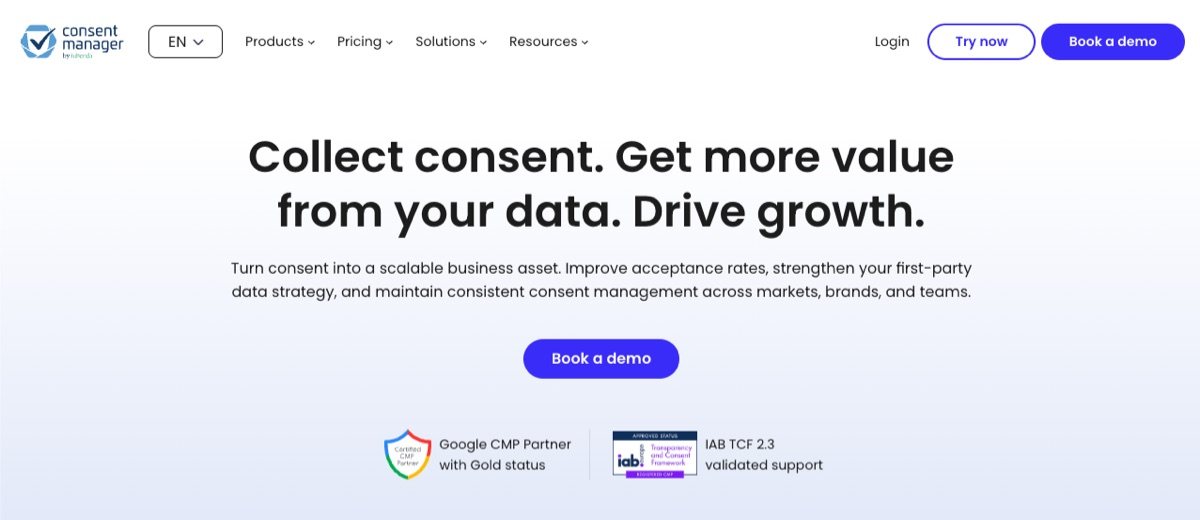
consentmanager by iubenda is enterprise-grade consent and CMP infrastructure, built for the case where the consent rate is a revenue number. It does the optimization itself rather than leaving it to whoever has time: A/B testing compares layouts, wording, and button positions, and machine learning moves traffic to the version that performs best.
It runs across web, mobile apps, and connected TV from one configuration, which matters when the same brand appears on five properties in three markets. It is IAB TCF v2.3 validated and a Google-certified CMP at Gold status, so demand partners can bid without the setup blocking them.
What you get
- Acceptance rates that improve without manual test cycles, through A/B testing and machine learning that promote the best-performing layout
- Benchmark reports showing how your consent rate compares with similar properties, so the number has context
- One configuration across domains, brands, and markets, instead of a per-site setup to maintain
- IAB TCF v2.3 validation and Google-certified CMP status at Gold, so demand partners can bid without your setup blocking them
- Consent across web, mobile apps, and connected TV from the same configuration
- Compliance monitoring that flags gaps and gives you the next step
- Published pricing and a free tier, so you can see the number and test before committing
Trade-offs
- There is real configuration depth, so expect an implementation period rather than an afternoon, with support alongside you
- It is built for scale, which makes it more platform than a single small site needs
Pricing: published openly, paid plans from €23/month, with a free plan to test on.
Best for: publishers and enterprises whose ad and analytics revenue depends on acceptance rates.
2) Didomi
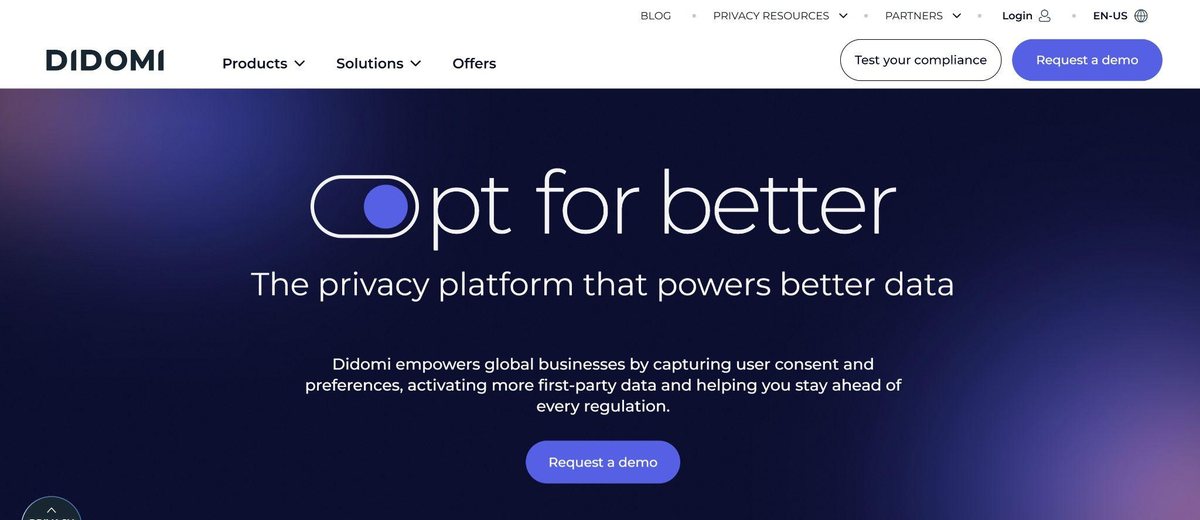
Didomi is an enterprise-grade CMP built around consent optimization, with A/B testing, multi-domain support, and consent across devices and channels. It is used at enterprise scale.
The distinction that matters for a publisher is who runs the optimization. Didomi gives you the testing tools; someone on your side designs the tests, reads the results, and decides what to ship. That is a capable setup if you have the analyst time, and a stalled one if you do not.
What you get
- A/B testing of consent experiences, run manually
- Enterprise multi-domain support
- IAB TCF validated and Google-certified
- Consent across devices and channels
- A support experience reviewers rate highly
Trade-offs
- A/B testing is manual, so consent rates improve only as fast as someone runs and reviews the experiments
- No benchmark reporting, so your consent rate has no external reference point
- Consent only: no legal document generation and no compliance monitoring
- Reviewers mention added page weight
- No published pricing and no free tier to test on
Pricing: not published, quote only. No free tier.
Best for: enterprises with the analyst time to run consent experiments themselves.
3) OneTrust
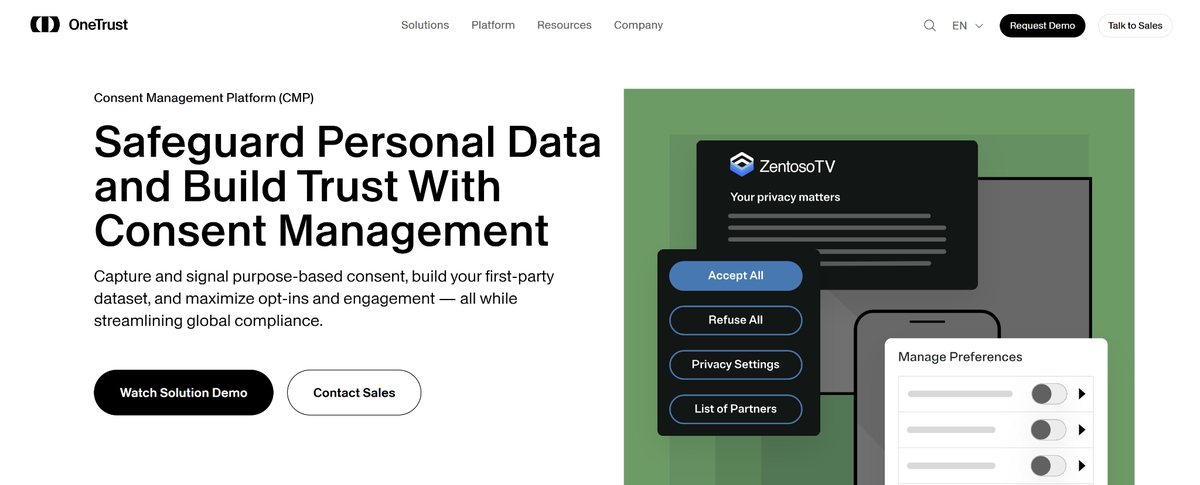
OneTrust is a governance platform that includes consent and preference management alongside privacy automation, third-party risk, and AI governance. Consent is one module within it rather than the product.
What you get
- Consent and preference management inside a much wider governance platform
- A/B testing within the consent module
- Consent across websites, apps, and connected TV
- Privacy automation, third-party risk, and AI governance alongside consent
Trade-offs
- No published pricing; third-party estimates run into the tens of thousands per year, with modules charged per regulation
- Implementation is measured in weeks or months and generally needs dedicated ownership
- Reviewers report slow support
Pricing: not published, quote only. No free tier.
Best for: large enterprises that need governance breadth and have budget to match.
4) Cookiebot
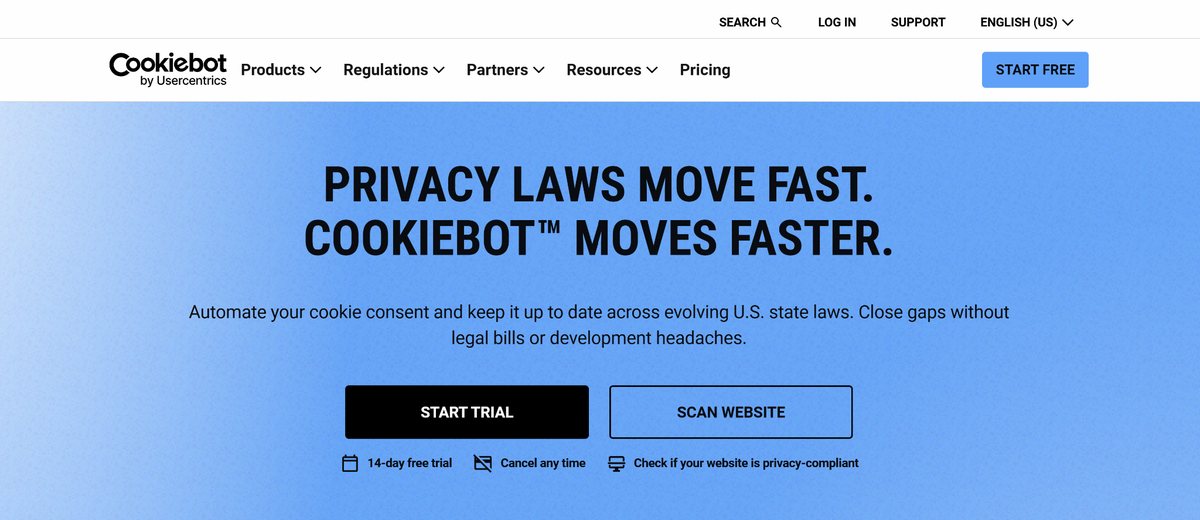
Cookiebot is a cookie-focused CMP: automated scanning, automatic categorization, and consent collection, with geotargeting and cross-domain consent sharing.
For a publisher the difference is what happens after the banner loads. Cookiebot reports your consent rate; it does not work on it. If that number is tied to revenue, reporting alone leaves the upside on the table.
What you get
- Automated cookie scanning with automatic categorization
- An opt-in and opt-out analytics dashboard
- Geotargeting for region-specific consent experiences
- Cross-domain consent sharing
- IAB TCF validated and Google-certified
Trade-offs
- No A/B testing: you get statistics on your consent rate, but nothing that improves it
- Pricing is based on sub-page count rather than traffic, which is harder to forecast on a large content site
- Reviewers report added page weight
Pricing: published openly from €7/month, with a free plan.
Best for: sites that need a solid cookie scanner and are not trying to move their consent rate.
5) iubenda
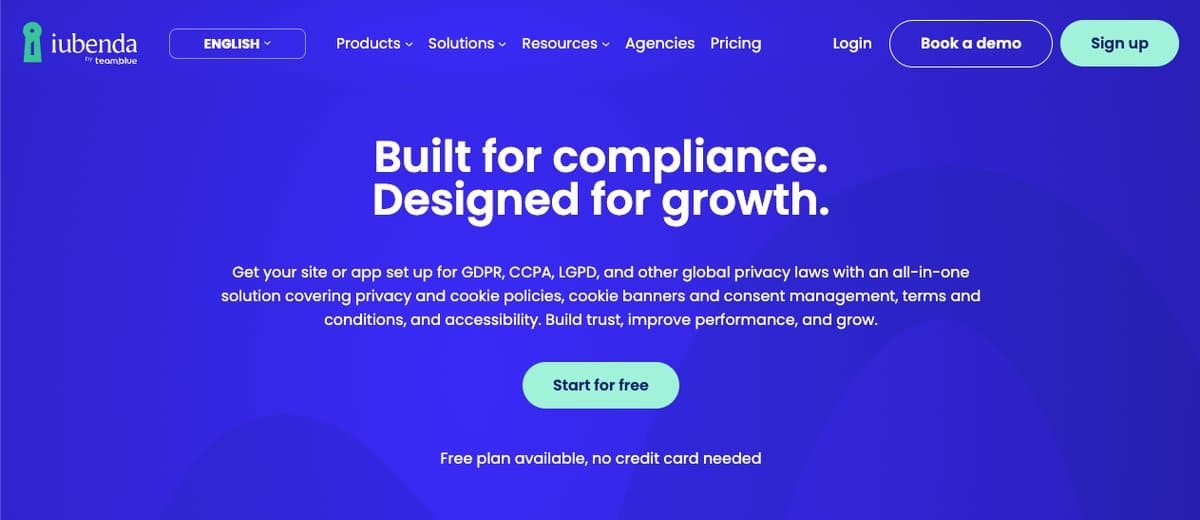
iubenda is part of the same group as consentmanager and takes a different angle: one subscription covering cookie consent, legal documents, accessibility, data subject rights, and whistleblowing.
What you get
- Legal documents generated from a scan of the services your site actually runs, with recurring scans
- Consent analytics and consent recovery
- Accessibility, data subject rights, and whistleblowing on the same subscription
- IAB TCF v2.3 validated and Google-certified
- A lightweight script engineered to keep INP in the green
Trade-offs
- Less specialized than consentmanager on acceptance-rate optimization: no A/B testing or machine-learning layout selection
- Built for breadth across compliance rather than depth on publisher consent economics
Pricing: published openly from €4.99/month, with a free plan.
Best for: groups that want consent, legal documents, accessibility, and data subject rights on one subscription.
Choosing between them
- Is your consent rate a revenue number someone reports on? Then automatic optimization is the deciding feature, and only consentmanager does it without manual test cycles.
- How many properties? Past a handful of domains, shared configuration and benchmark reporting matter more than any single banner feature.
- Do you want published pricing and a free tier to test on? consentmanager, Cookiebot and iubenda have both. Didomi and OneTrust have neither.
- Do you also need governance? If AI and data governance are genuine requirements, OneTrust is the only one on this list built for it.
Frequently asked questions
What is the best Usercentrics alternative for publishers?
For publishers whose revenue depends on acceptance rates, consentmanager, because it improves those rates automatically through A/B testing and machine learning rather than leaving the testing to your team.
Will switching CMP affect my ad revenue?
It affects the consent rate, which affects addressable inventory. That is the reason to switch deliberately rather than quickly: measure your current acceptance rate first, so you can tell whether the new setup improved it.
Which of these support IAB TCF and Google Consent Mode?
All five are IAB TCF validated and Google-certified, which is the baseline for running programmatic demand. consentmanager is validated against TCF v2.3 and certified at Gold status. Confirm the current specification with each provider when you implement, since frameworks change.
How long does migration take?
It depends on how many domains and channels you run, and how much of your current setup is custom. The honest answer is that it is a scoping question rather than a number, which is what an implementation conversation is for.
See what your consent rate could be
The gap between a default banner and an optimized one is measured in percentage points of addressable audience, across every pageview you serve. It is worth knowing what that gap is on your properties before you renew anything.
Book a demo and we will walk through your current setup, your acceptance rate, and where the recoverable upside actually is.
For a feature-by-feature comparison of the two platforms outside the publisher context, see consentmanager vs Usercentrics.